Being is constrained to the horizon of possibility — all that exists, exists only insofar as it is possible.
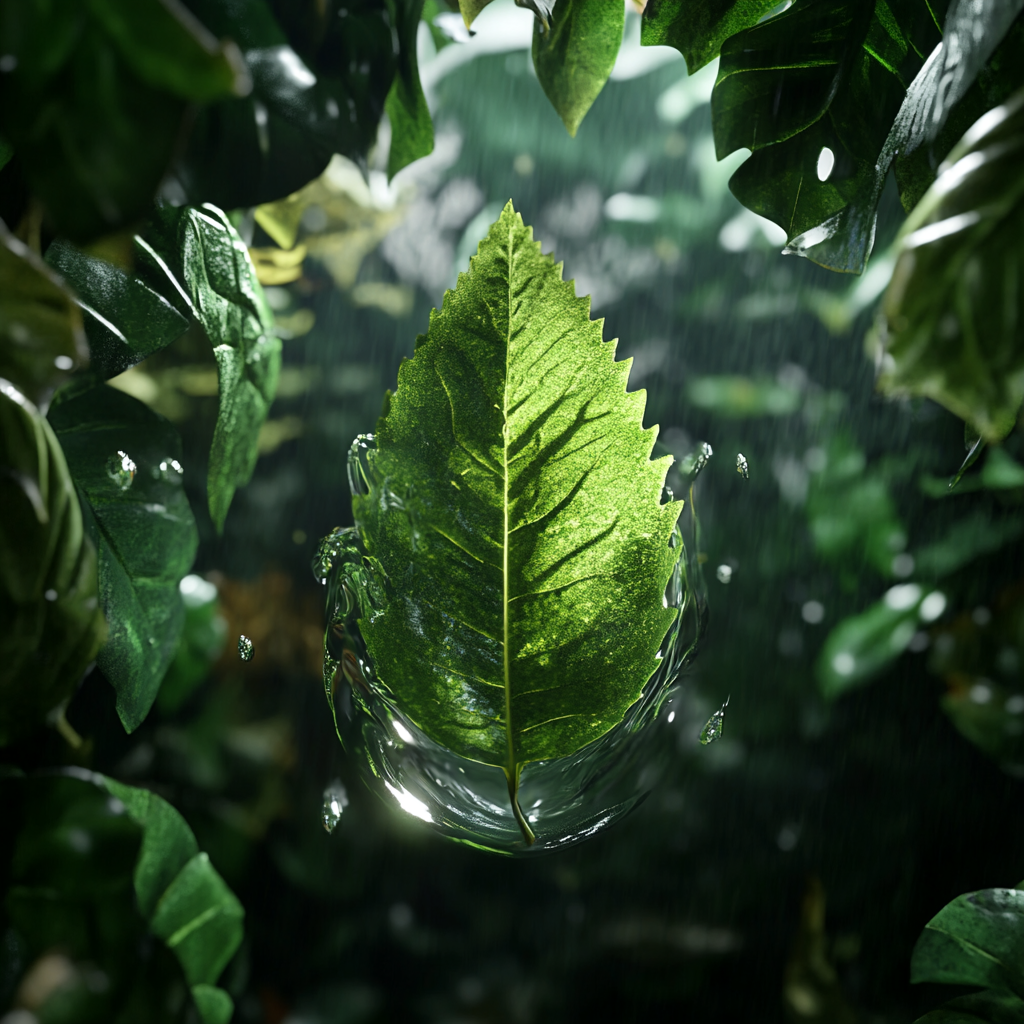
If your god has eyes, then god is not.
Plants grow from the air.
Not from the soil, as distracted eyes suppose.
The earth offers them support, a handful of minerals, and water.
But the wood, the leaf, the stem — all of this is forged from the invisible.
The carbon that sustains the tree comes from the sky.
Taken, atom by atom, from the carbon dioxide drifting in the wind.
Using sunlight as a scalpel, the plant sculpts matter with ancestral precision.
It breathes the air, captures the light — and makes existence.
But not just any light.
The plant is selective.
It accepts the deep blue and the warm red.
But it rejects the green.
Green lacks the right energy.
It doesn’t fit. It doesn’t resonate at the exact frequency of its reactions.
And so, what it cannot use, it returns to the world.
That’s why we see it as green.
Because green was refused.
We do not see the essence of the plant —
We see what it is not.
We see the waste of photosynthesis.
And thus, we perceive the world by what things do not absorb, by what they let escape.
We are eyes of the possible, sensors of the leftover.
We are filters of reality.
Our physiology was shaped by what vibrated before us.
Light was already dancing before the eye.
The electromagnetic field pulsed long before any brain interpreted it as “color.”
We are latecomers. We came after.
And because we came after, we can only touch what resists absorption.
Our world is made of what escapes fusion, of what reflects.
Of what refuses to be possessed.
Perhaps that is why reality slips away from us so easily.
Perhaps that is why we seek the absolute — because everything that reaches us is already a shadow of what was not absorbed.
To see is to lose.
To perceive is to be posterior. To be is… merely what is possible to be.
The tree does not grow from the soil. It grows from the air.
This statement, which Richard Feynman considered one of the most extraordinary in science, may sound absurd to common sense. But it is chemically precise: most of a plant’s biomass comes from atmospheric carbon dioxide (CO₂), not from the soil.
“When trees grow, where does their substance come from? […] It comes from the air. All the wood burns and goes back to the air. It’s a reversal.” — Richard Feynman, The Feynman Lectures on Physics
Photosynthesis is the fundamental process: the plant captures solar photons and uses that energy to extract carbon from CO₂, combining it with hydrogen from water to form glucose and other organic structures. Light energy is stored in matter. This transfer is not only energetic but informational. Each photon carries not just energy but data about the cosmos. The plant “reads” this quantum information, encoded in the dual properties of the photon — both particle and wave. By capturing certain wavelengths and rejecting others, the plant not only grows but processes information, translating the language of light into biochemical structure. At this interface between light and living matter, we encounter Earth’s first great information-processing system — long before our computers. The leaf is, in essence, a primordial quantum processor transforming cosmic data into terrestrial substance.
Light is not absorbed continuously.
It is composed of photons — discrete packets of energy. And chlorophyll, the plant’s photosynthetic pigment, accepts only certain photons — those whose energy perfectly matches the quantum energy gaps between its electron states.
This absorption is governed by quantum mechanics, by principles like energy quantization and wave-particle duality.
“Every time light is absorbed, a quantum jump occurs.” — Werner Heisenberg, Physics and Philosophy
This process is far more sophisticated than it seems. At the heart of photosynthesis, protein complexes such as Photosystem I and II function as quantum antennas, where photon energy is transferred through quantum superposition states. The electron transfer doesn’t follow deterministic paths but explores multiple routes simultaneously, using quantum coherence to achieve astonishing efficiencies. When a chlorophyll molecule captures a red or blue photon, it triggers not just a chemical reaction — but a cascade of quantum possibilities collapsing into a determined process. In a sense, the plant computes at the quantum scale, optimizing energy pathways through probabilistic states. Photons in the blue-violet range (~430 nm) and red (~660 nm) are absorbed. But green (~500-550 nm) is rejected — its energy is incompatible. It is reflected, scattered — returned to the world. This energetic rejection has a perceptual consequence: we see leaves as green because green is what they do not absorb.
In other words, we see what the plant is not. This inversion — perceiving being by what it rejects — echoes through philosophy:
“The real reveals itself in what refuses total presence.” — Martin Heidegger, Being and Time
We do not see the plant’s inner essence but the remainder of its interaction with light. The plant is made of absorbed photons — but we see only what it declined. This perceptual inversion — where being reveals itself by what it rejects — is just one of the paradoxes at the frontier between classical and quantum reality. And perhaps it is no coincidence that life, through photosynthesis, operates precisely at this frontier. As we progress in understanding and manipulating the code of life, we discover that biological information — DNA, RNA, proteins — also follows encoding and decoding principles not so different from those that govern photons. Life is, in essence, structured information that self-organizes and replicates.
And if life is based on information, and information can be transmitted by photons, we begin to glimpse how these boundaries — between light and matter, between information and substance, between biology and technology — are far more permeable than we ever imagined.
Our physiology is not neutral.
Our eyes detect only a narrow band of the electromagnetic spectrum — between 400 and 700 nanometers. This range was selected by evolution for its usefulness, not for its truth.
“The purpose of perception is not truth, but survival.” — Donald Hoffman, neuroscientist
What does not resonate with us — ultraviolet, infrared, microwaves — exists, but is not perceived. We are late structures shaped by prior fields. Light existed before eyes. Electrons became excited long before any observer.
If we consider information as a fundamental property of the universe — as fundamental as energy or matter — then our limited perception also represents a limited capacity for information processing. Claude Shannon demonstrated that information is defined by the reduction of uncertainty, by narrowing possibilities.
Thus, when the plant rejects green, it is, in informational terms, reducing uncertainty — eliminating possibilities to create order out of luminous chaos. And we, by perceiving only certain bands of the spectrum, follow the same principle. To perceive is fundamentally to filter — an act of informational selection. The entire universe can be seen as a vast field of information where each entity — be it plant, animal, or machine — acts as a specialized processor, filtering and interpreting data according to its structure and purpose.
Here we arrive at the ontological statement that runs through this essay: everything we perceive is what could be perceived. Reality is vastly greater than its appearance.
“The world is everything that is the case.” — Ludwig Wittgenstein, Tractatus Logico-Philosophicus
But what is “the case” for us is what was possible within the conditions of our body, our time, our mind. Being appears only on the horizon of possibility. Everything that is for us is what escaped absorption. Consciousness — that inner clarity pretending to encompass the world — is, at best, a side effect of prior interactions. We did not create light. We were shaped by it.
“Matter is the shadow of light.” — Erwin Schrödinger, What Is Life?
Just as the leaf rejects green, we reflect the world but do not absorb it in its entirety. To perceive is to come after. To know is to recognize what was left aside.
And perhaps, as Nietzsche said, “There are no facts, only interpretations.”
The green we see is the mark of refusal. The plant is made of what we do not see. And we are made of what we could see. Reality, then, is not what stands before us, but what exists beyond our filters — and continues to be, even when it can no longer touch us.
This understanding of selective perception opens pathways toward the extension of human consciousness. While our biological eyes capture only a tiny fraction of the spectrum, our instruments already expand our perception beyond those limits. As we integrate technology and biology — moving toward what we might call homo machina — we are not merely augmenting capabilities, but fundamentally transforming our perceptual relationship with the universe.
What would it mean to perceive beyond the rejected green? To see in ultraviolet like bees, to sense infrared like snakes, or to detect magnetic fields like migratory birds? Technological integration promises not just sensory amplification but an ontological restructuring — a new way of being in the world.
If your god sees, it too does not escape the rejected green.
And perhaps, then, the divine lies beyond what can be seen.
Our machines follow a similar path. Our technological sensors capture what our senses cannot. Our algorithms process information at speeds and volumes our brains could never sustain. Our quantum devices begin to operate at the same quantum frontiers that photosynthesis has explored for billions of years. Is our technology not then a natural extension of this evolutionary process of capturing and processing information? Is homo machina not simply the next step in this dance between being and information, which began when the first chlorophyll molecule captured a photon? The integration between human and machine can be seen not as rupture, but as continuity — a refinement of our ability to filter, process, and respond to the vast informational symphony of the cosmos. Technology does not distance us from nature; it reconnects us to its fundamental processes through new channels.
Perhaps the entire universe is determined not by what exists absolutely, but by which frequencies (ν) are captured and processed by the systems that inhabit it. Planck’s equation, E = hν, is not just a description of photon energy — it is an ontological key. Planck’s constant (h) defines the fundamental granularity of the universe, the smallest possible energy packets. But it is frequency (ν) — and which frequencies are absorbed or reflected — that determines how reality manifests for each system.
The plant exists in a universe of absorbed red and blue.
We exist in a universe of reflected green.
The bat inhabits a world built of ultrasonic echoes.
The snake perceives a cosmos of infrared radiation.
Each living being is a quantum filter tuned to capture certain frequencies and ignore others. We do not experience reality — we experience the result of our selective filters upon it. Consciousness, in this sense, is not a passive mirror but an active oscillator resonating only with certain frequencies of the cosmos. To perceive is to enter into resonance with specific frequencies that our biological systems evolved to capture. As we develop technologies that expand our ability to detect and process frequencies beyond our biological filters, we are not merely amplifying perception — we are fundamentally altering who we are. Homo machina is not just an augmented human; it is an entity that exists within a universe of previously inaccessible frequencies.
Our instruments already extend our perceptual reach from radio waves to gamma rays. Our detectors capture gravitational waves and quantum fluctuations. Each new frequency accessed not only reveals more of the universe — it creates a new universe for the observer. When we integrate these technologies not merely as external tools but as extensions of our being, we transform our own ontology. The reality we inhabit expands with every new frequency we can process.